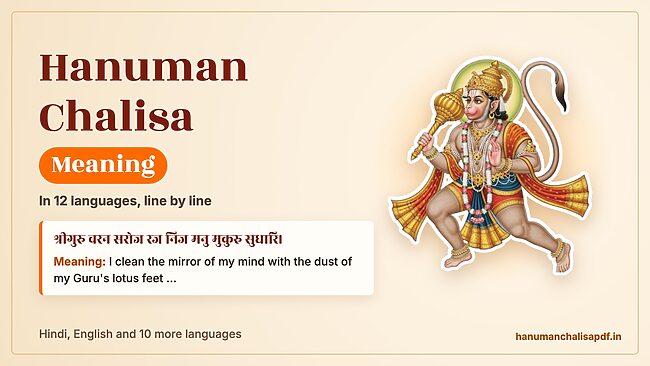
Hanuman Chalisa Meaning in 12 Languages

The whole Hanuman Chalisa with a simple meaning of every doha and chaupai, in 12 languages. Pick your language below, or download the meaning PDF for free.

Hanuman Chalisa Meaning in Your Language

The Hanuman Chalisa is Goswami Tulsidas’s prayer to Hanuman ji, written in Awadhi. In forty chaupais it sings of Hanuman ji’s strength, his wisdom and his love for Shri Ram, and it asks him for strength, wisdom and knowledge. Pick your language to read the meaning of every line, with a short explanation, or to download it as a free PDF.

Hindi · English · Assamese · Bengali · Gujarati · Kannada · Malayalam · Marathi · Nepali · Odia · Tamil · Telugu

Hindi (हिंदी)

हनुमान चालीसा अर्थ सहित

Assamese (অসমীয়া)

হনুমান চালিশা অসমীয়া অৰ্থ

Bengali (বাংলা)

হনুমান চালিশা বাংলা অর্থ

Gujarati (ગુજરાતી)

હનુમાન ચાલીસા ગુજરાતી અર્થ સાથે

Kannada (ಕನ್ನಡ)

ಹನುಮಾನ್ ಚಾಲೀಸಾ ಕನ್ನಡ ಅರ್ಥ

Malayalam (മലയാളം)

ഹനുമാൻ ചാലിസ മലയാളം അർത്ഥം

Marathi (मराठी)

हनुमान चालीसा मराठी अर्थ सहित

Nepali (नेपाली)

हनुमान चालीसा नेपाली अर्थ

Odia (ଓଡ଼ିଆ)

ହନୁମାନ ଚାଳିଶା ଓଡ଼ିଆ ଅର୍ଥ

Tamil (தமிழ்)

அனுமன் சாலிசா தமிழ் பொருள்

Telugu (తెలుగు)

హనుమాన్ చాలీసా తెలుగు అర్థం

For the Chalisa alone, without the meaning, the one page and big letter PDFs of all twelve languages are on our PDF download page.

Hanuman Chalisa Summary

What the Hanuman Chalisa says, in short. The meaning of every line is on the pages above.

The opening dohas. Tulsidas cleans the mirror of his mind with the dust of his Guru’s feet, so that he can sing the pure glory of Shri Ram. Then, knowing that he has little wisdom, he remembers Hanuman ji and asks him for strength, wisdom and knowledge, and to take away his troubles.

Chaupai 1 to 10: who Hanuman ji is. He is an ocean of knowledge and good qualities, Shri Ram’s messenger, and the son of Anjana and of the Wind god. His body is as strong as a vajra, he is learned and clever, and he loves to hear Shri Ram’s story. He took a tiny form to meet Sita ji and a fearsome one to burn Lanka.

Chaupai 11 to 20: what he did for Shri Ram. He brought the sanjeevani herb and saved Lakshman ji, and Shri Ram hugged him and said he was as dear as Bharat. He brought Sugreev to Shri Ram, and on his advice Vibheeshan became the king of Lanka. As a child he took the sun for a sweet fruit, and he crossed the ocean with Shri Ram’s ring in his mouth. With his grace, every hard task becomes easy.

Chaupai 21 to 30: Hanuman ji the protector. He guards Shri Ram’s door. The Chalisa says that those who come to his shelter have nothing to fear, that ghosts and evil spirits stay away where his name is said, and that he frees from trouble whoever keeps him in mind in thought, deed and word. His glory shines in all four yugas, and he protects sadhus and saints.

Chaupai 31 to 40: his gifts, and the prayer. Sita ji gave him the boon to grant the eight siddhis and the nine nidhis, and he holds the medicine of devotion to Ram. Through his bhajan a devotee reaches Shri Ram. The last chaupais speak of reading the Chalisa a hundred times, and Tulsidas, forever Shri Ram’s servant, asks Hanuman ji to make his home in his heart.

The closing doha. A last prayer to the son of the Wind, who removes troubles: live in my heart, along with Shri Ram, Lakshman ji and Sita ji.

How These Meanings Are Written

Every meaning page has the whole Hanuman Chalisa in that language’s script, the same text on every page. Under each doha and chaupai is its meaning in simple words and a short explanation. We wrote the meanings once in Hindi and then in each language in everyday words, so all twelve pages explain each line the same way. These are our own simple meanings, and learned people explain a few chaupais in other ways too. For a deeper reading, see a commentary or ask a pandit. The meaning of each word is on our word by word meaning page.

Frequently Asked Questions

Questions people often ask about the meaning of the Hanuman Chalisa.

What is the meaning of the Hanuman Chalisa?
It is a prayer of praise to Hanuman ji. In forty chaupais, Goswami Tulsidas sings of Hanuman ji’s strength, wisdom and devotion to Shri Ram, tells his stories from the Ramayan, and prays to him to remove troubles and to live in our heart along with Shri Ram. A short summary is above, and the meaning of every line is on the page for your language.
In which language is the Hanuman Chalisa written?
In Awadhi, the old Hindi of the Ayodhya region. Goswami Tulsidas, who also wrote the Ramcharitmanas, wrote it. It is not Sanskrit, though many of its words come from Sanskrit. Our twelve pages give the same Awadhi text in each language’s script, letter for letter, with the meaning in that language. How it came to be written is on our history page.
What is the difference between arth and bhavarth?
Arth is what a line says, in plain words. Bhavarth is the idea behind it: the story it points to and what it teaches. On our pages every doha and chaupai has both, under the headings Meaning and Explanation (अर्थ and भावार्थ on the Hindi page).
Where can I read the Hanuman Chalisa meaning line by line?
On the twelve meaning pages above. Each doha and chaupai is shown with its meaning right under it, and every verse has its own link, so you can open or share a single line. For example, chaupai 18 (the sun taken for a fruit) in English is here.
Where can I find the word by word meaning?
On our word by word meaning page. The pages here explain each line as a whole; that page gives the meaning of each word, which helps when you are learning the Chalisa.
Can I download the Hanuman Chalisa with meaning PDF?
Yes, free, in all twelve languages. Each PDF has the full text and the simple meaning of every doha and chaupai, in 5 to 7 pages. Tap “Meaning PDF” under your language above. The one page and big letter PDFs of the text alone are on our PDF download page.
Is this the Gita Press Hanuman Chalisa with meaning?
The verses follow the Gita Press, Gorakhpur edition and are checked against it line by line. The meanings are our own, written in simple words, and the PDFs are made by us.
What is the spiritual meaning of the Hanuman Chalisa?
Our pages give the plain meaning and a short explanation. Saints and scholars find deeper meanings in it too, for example Jagadguru Rambhadracharya ji in his Hindi commentary “Mahaviri Vyakhya”. At its simplest, the Chalisa shows great strength used with humility in the service of Shri Ram, and asks for that same devotion in our own heart.
Is there a simple Hanuman Chalisa meaning for kids?
The meanings on our pages are short and in simple words, so children can read them with you. Many children like to start with the stories: young Hanuman ji taking the sun for a fruit (chaupai 18) and bringing the sanjeevani herb for Lakshman ji (chaupai 11). There is more for children on our Hanuman Chalisa for students page.
हनुमान चालीसा का मतलब क्या है?
हनुमान चालीसा गोस्वामी तुलसीदास जी की अवधी रचना है। दो दोहों से शुरुआत होती है, फिर चालीस चौपाइयों में हनुमान जी के गुण, बल, राम-भक्ति और उनकी कथाएँ हैं, और एक दोहे से समापन। इसका सार है: हनुमान जी से बल, बुद्धि और विद्या माँगना, और उनके साथ श्रीराम को हृदय में बसाना। हर दोहे और चौपाई का आसान अर्थ हमारे हनुमान चालीसा अर्थ सहित पेज पर है।

Also on this site: Hanuman Chalisa PDF download · Listen to the audio · Watch the video

Saurabh Satyaram

Runs this site · Jaipur, Rajasthan

I am a Hanuman bhakt from Jaipur, not a pandit or a scholar. I check every verse on this site line by line against the standard printed text, and I write the meanings in simple words, from my own understanding, checked against two published commentaries. If you find a mistake, please tell me on the contact page.
How this site is made

Join Our Devotee Community

Connect with other devotees on Telegram, Facebook and YouTube. Our channels share Hanuman Chalisa content in Hindi and English.