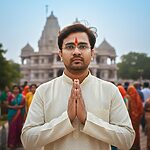
Every year, on one particular dawn, something shifts in India.
Temples open before 4 AM. Queues form in the dark. The sound of Hanuman Chalisa rises from speakers across cities and villages. Trucks roll through neighborhoods with Hanuman’s image on the bonnet, orange flags streaming from the cab. Processions move slowly through streets, devotees carrying oil lamps and garlands.
This is Hanuman Jayanti (हनुमान जयंती) — the birth anniversary of Lord Hanuman, observed by hundreds of millions of Hindus across the world. It is not just a religious event. It is one of the most widely felt expressions of collective devotion in human culture.
What Is Hanuman Jayanti?
Hanuman Jayanti marks the day Lord Hanuman was born — the day Anjana (अंजना) and Vayu (वायु, the wind god) brought into the world a being of infinite strength, wisdom, and humility.
The day is observed on Chaitra Purnima — the full moon day (पूर्णिमा) of the month of Chaitra in the Hindu lunar calendar. In the Gregorian calendar, this usually falls in March or April. The exact date changes each year based on the lunar calendar, so check a Hindu Panchang (पंचांग) for the precise date in your year.
In some South Indian traditions, particularly in parts of Karnataka and Tamil Nadu, Hanuman Jayanti is observed on the new moon day of the Margashirsha month (December). Both observances are valid — they follow different regional calendars.
When Is Hanuman Jayanti in 2027?
In 2027, the widely observed North Indian Hanuman Jayanti falls on Tuesday, April 20, 2027, coinciding with the Chaitra Purnima.
Because regional traditions follow different lunar calendars, the observance date varies depending on your location:
- General/North India: Tuesday, April 20, 2027
- Tamil Nadu (Hanumath Jayanthi): Commences on Thursday, January 7, 2027, and another observance on Monday, December 27, 2027
- Andhra Pradesh/Telangana: Starts on Chaitra Purnima and extends over 41 days, with the final celebrations on Monday, May 31, 2027
Why This Day Matters More Than Most People Realise
If you want to understand who Lord Hanuman was and why his birth matters, the story of Hanuman Jayanti is the place to start. He was born from divine blessings — his mother Anjana received the grace of Vayu after years of tapas, and the result was a being who embodied all the qualities that Vedic tradition considers the highest combination: strength without arrogance, intelligence without pride, devotion without self-interest.
Hanuman Jayanti is celebrated with such intensity because Hanuman Ji is not a distant deity in a story. He is the Sankat Mochan (संकट मोचन) — the one who removes real, present suffering from real, present lives. For devotees, this day is not a historical commemoration. It is a direct meeting.
How to Celebrate Hanuman Jayanti — Simple Puja Vidhi
The celebration does not require elaborate preparations. What follows is the puja vidhi observed in most Hanuman-devoted households.
Morning: Before Sunrise
Wake up early — ideally in Brahma Muhurta (4–5:30 AM). Bathe and wear clean clothes, preferably red or orange. Set up a clean space with Hanuman Ji’s image or idol.
Offer: sindoor (सिंदूर), red flowers (especially marigold), a lamp with sesame or mustard oil, and banana or jaggery as prasad. Then begin with a full recitation of the Hanuman Chalisa. On Jayanti, most devotees recite it 5 or 11 times rather than once.
During the Day
Many devotees fast on Hanuman Jayanti — eating only once after sunset, or subsisting on fruits. This mirrors the Tuesday fast, which is Hanuman Ji’s dedicated weekly day. Jayanti is its annual equivalent and carries far greater significance.
Visit a Hanuman temple if possible. In most towns and cities, temples hold special events — extended Chalisa recitations, Sunderkand path, and bhajan sessions throughout the day.
If you cannot visit a temple, continue recitations at home. The benefits of chanting the Hanuman Chalisa are heightened on this day — traditional belief holds that every recitation on Jayanti carries the weight of 100 recitations on an ordinary day.
Evening: Aarti and Closing Puja
As the sun sets, light a fresh lamp and close the day’s puja with the Hanuman Aarti. Distribute prasad — banana, laddoo, and besan sweets are traditional. Offer sindoor to Hanuman Ji’s image and, in many traditions, mark a tilak on your own forehead with the sindoor from the offering.
What to Chant on Hanuman Jayanti
In order of traditional priority:
- Hanuman Chalisa — the foundation. Recite at least once; more if you can. You can download the PDF free in Hindi and English for printed reference during long sessions.
- Sundarkand (सुंदरकांड) — the chapter of the Ramcharitmanas that focuses entirely on Hanuman. Reciting the full Sundarkand is a common Jayanti observance.
- Hanuman Ashtak — eight verses specifically praising Hanuman’s deeds
- Hanuman Aarti — at the beginning and end of puja
If you are new to the Chalisa and want to deepen your understanding on this day, take the time to read the meaning of the Hanuman Chalisa verse by verse — Jayanti is the ideal day to go beyond recitation into comprehension.
Common Questions About Hanuman Jayanti
Can women observe the Hanuman Jayanti fast and puja? Yes, completely. There is no traditional restriction on women’s participation in Hanuman Jayanti observances.
Is fasting mandatory? No. Full devotional participation without fasting is equally valid. The fast is a form of physical offering — the puja and the Chalisa recitation are the core.
What if I can’t get to a temple? A home puja with a lamp, an image of Hanuman Ji, and sincere recitation is entirely complete. Hanuman Ji’s worship was specifically designed to be independent of temples.
How many times should I read the Chalisa on Jayanti? Once is the minimum. 5, 11, or 21 times are common choices. Some dedicated devotees complete 108 readings across the day. Start with what you can sustain sincerely.
What should I eat after breaking the fast? Traditionally: saatvik (सात्विक) food — no onion, garlic, or non-vegetarian items on this day, even after breaking the fast.
Jai Bajrangbali! 🙏