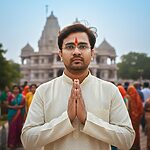
In most Hanuman temples across India, the puja follows a pattern that most devotees know without thinking about it.
The Chalisa is recited. Everyone present joins — sometimes the entire congregation, sometimes just a few voices. And then, just as the last verse of the Chalisa ends, the energy in the room changes.
The priest lifts the lit diya. The rhythm shifts from contemplation to celebration. And the Aarti begins.
आरती कीजे हनुमान लला की।
दुष्ट दलन रघुनाथ कला की॥
This is the Hanuman Aarti — the devotional song that closes Hanuman Ji’s worship. Understanding what it says and why it matters completes the picture of how Hanuman Ji is actually worshipped.
What Is an Aarti?
Aarti (आरती) is a ritual of light and music. A lamp — traditionally with five flames arranged in a specific pattern — is waved in circular motions before the deity. The circular movement represents the eternal, unbroken nature of the divine. The light represents knowledge driving out darkness.
An Aarti is always sung, never silently recited. It’s communal by nature — the sound rising from many voices simultaneously is itself part of the offering. The shift from the measured recitation of the Chalisa to the more celebratory rhythm of the Aarti is intentional: you move from devotional reflection to joyful praise.
The sequence always goes: Chalisa first, Aarti last. The Chalisa is a devotional work. The Aarti is the celebration.
Hanuman Aarti — Complete Lyrics with Meaning
आरती कीजे हनुमान लला की।दुष्ट दलन रघुनाथ कला की॥
“Let us perform the aarti of beloved Hanuman — the destroyer of the wicked, skilled in the service of Lord Ram.”
जाके बल से गिरिवर काँपे।रोग दोष जाके निकट न झाँके॥
“At whose strength even the great mountains tremble — disease and misfortune dare not come near him.”
अंजनि पुत्र महा बलदाई।संतन के प्रभु सदा सहाई॥
“Son of Anjana, the great bestower of strength — the Lord who always stands beside his devotees.”
दे बीड़ा रघुपति पठाए।लंका जारि सिया सुधि लाए॥
“Sent with a betel leaf offering by Lord Ram — he burned Lanka and brought news of Sita.”
लंका सो कोट समुद्र सी खाई।जात पवनसुत बार न लाई॥
“Lanka with its fortress walls and ocean moat — the son of the wind crossed it without a moment’s hesitation.”
लंका जारि असुर संहारे।सियाराम के काज सँवारे॥
“He burned Lanka, vanquished the demons — and completed every mission of Sita and Ram.”
लक्ष्मण मूर्छित पड़े सकारे।आनि संजीवन प्राण उबारे॥
“When Lakshmana lay unconscious at dawn — he brought the Sanjeevani herb and saved his life.”
पैठि पाताल तोरि जमकारे।अहिरावण की भुजा उखारे॥
“He entered the underworld and broke Yama’s locks — and tore off the arms of the demon Ahiravan.”
बाईं भुजा असुर दल मारे।दाहिनी भुज संत जन तारे॥
“With his left arm he slew the armies of demons — with his right arm he lifts up the saints.”
सुर नर मुनि जन आरती उतारें।जय जय जय हनुमान उचारें॥
“Gods, humans, and sages perform this aarti — Victory, victory, victory — the name of Hanuman resounds.”
कंचन थार कपूर लौ छाई।आरती करत अंजना माई।।
“With a golden plate, the camphor flame spreading its light — Mother Anjana herself performs the aarti of her son.”जो हनुमानजी की आरती गावै।बसी बैकुंठ परमपद पावै।।
“Whoever sings this aarti of Hanuman Ji — shall dwell in Vaikuntha and attain the supreme state.”
The Line That Deserves More Attention
Most people sing the Aarti from memory without pausing on any single line. But this one is worth stopping at:
“बाईं भुजा असुर दल मारे, दाहिनी भुज संत जन तारे”
With his left arm, he destroys demons. With his right arm, he protects devotees. The Aarti is describing two simultaneous functions — destruction of what is harmful, protection of what is sincere — operating at the same time, from the same being, through different arms.
This is the clearest summary in all of Hanuman’s worship literature of what he actually does. He isn’t just protective. He is actively destructive of evil and actively supportive of good. The same strength that burns Lanka is what carries a devotee through a crisis. It’s the same power, directed in opposite directions simultaneously.
When Is the Aarti Sung?
- Immediately after Hanuman Chalisa, at the end of any puja
- During the morning and evening lamp ceremonies in temples
- On Tuesdays and Saturdays, when a complete puja is performed at home
- During Hanuman Jayanti celebrations — sung collectively, often in processions
- At the end of Satsangs and devotional gatherings
The Aarti is rarely sung alone. It’s the closing note of a longer session — the celebration that follows the devotional work of the Chalisa. This sequence matters: you wouldn’t sing the Aarti first. You arrive at it.
Do You Need to Know Hindi to Sing It?
No. Many non-Hindi-speaking devotees in South India and in Indian communities abroad sing the Aarti by sound — by the sound and rhythm of the words, without full comprehension of every line. The sincerity carries regardless.
But knowing what you’re saying changes the experience. When you reach “Roga Dosh Jaake Nikat Na Jhaanke” — “disease and misfortune dare not come near him” — and you understand what those words mean, the line becomes a declaration, not just a melody. That’s the difference between singing and praying.